
Lafayette County Recent Arrests
The Lafayette County Sheriff's Office inmate search is the front door for any new county booking. It runs newest-first. Do not expect a newspaper-style police blotter. Stamps, Lewisville, or Bradley officers often make the arrest. Once the jail accepts the person, the county feed becomes the shared publication point. Posting takes time. Intake steps, fingerprinting, and data entry can leave a gap between the arrest and a public entry. Nothing promises a fixed display period.
Match the time window to your question. The focused Arrests Last 24 Hours page covers a same-day check and its fallback. The Police Blotter page tracks the feed across several days and explains why it is not a formal weekly log.
| View | Best use | Important limit |
|---|---|---|
| Official roster | Current and newest-first bookings, names, photos, dates, and agency | No stated 24-hour service promise or public retention policy |
| Same-day check | Review entries posted today, then recheck after processing | Arrest time and feed-post time may differ |
| Multi-day review | Compare older visible entries and release fields | Not labeled by LCSO as a complete weekly blotter |
Lafayette Overnight Booking Timing
Check the top of the official roster first. The feed sorts bookings newest-first, so last night's arrests should sit near the front. Search by name if the controls allow it. Compare the booking date with the arrest details instead of assuming they match. Still no entry? Intake processing may lag. Wait and check again before drawing conclusions. A missing name can also mean the person was cited and released, booked in another county, transferred, or listed under a different spelling.
For later custody or release status, the VINELink Custody Check fits better. VINE takes updates from participating county jails. It serves a different purpose than the photo-bearing roster, though. When online tools stay unclear, call LCSO on a verified number with a full name and an approximate arrest date. Ask a narrow custody question or file a records request. Skip social media posts and old copied photos.
Lafayette County Arrest Roster
The LCSO roster is the county's core booking view. Behind it sits an official app feed. Visitors see booking photographs plus search and sort controls. Each entry exposes a name, demographic details, a feed date, a release-date field, the arresting agency, and an official image. The jail's internal intake log holds more. Charge lists, booking numbers, bond amounts, warrant papers, officer details, exact confinement times, and final court outcomes may require another official source.
The official roster screen shows the search interface used for Lafayette County arrests. It is the same tool the sheriff publishes for public searches.
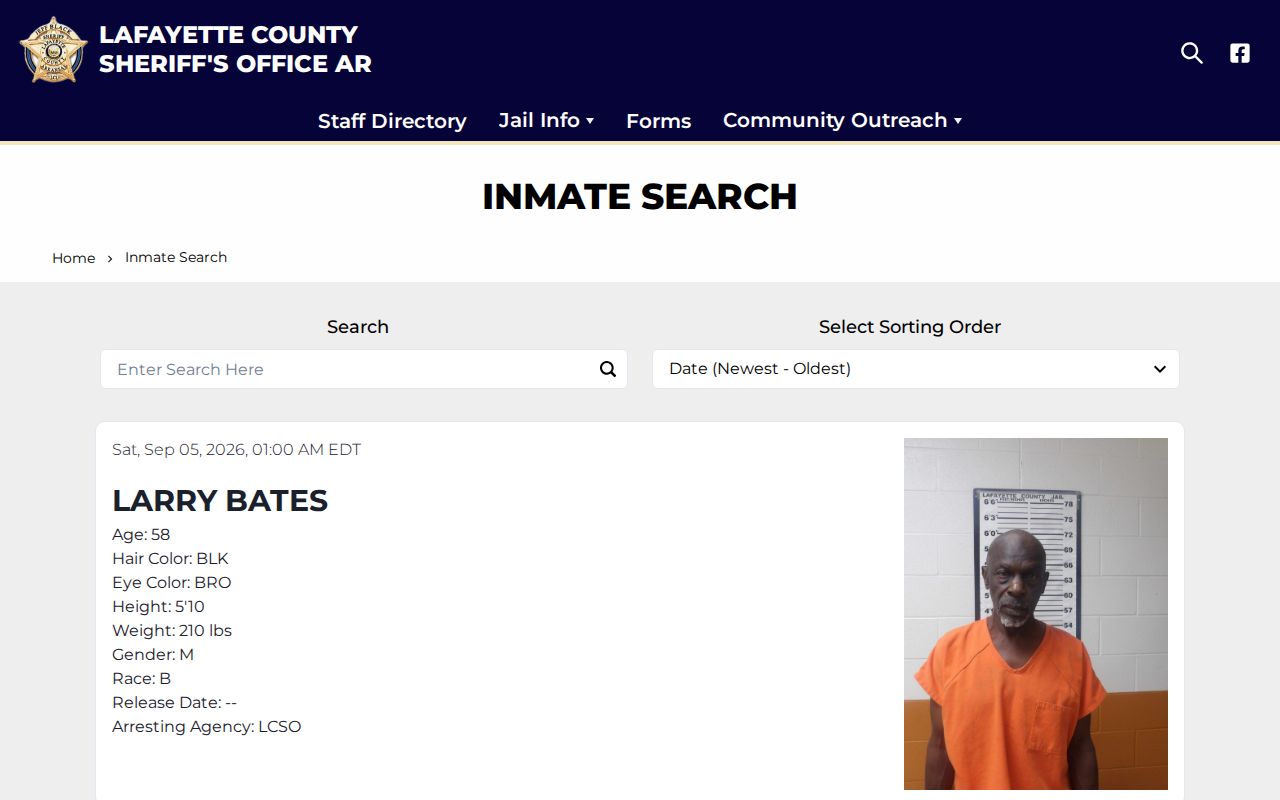
The sheriff's office runs the Lafayette County arrest roster. It shows who is in custody. The county posts no booking photo gallery. The page points to the official source.
| Public field | How to read it |
|---|---|
| Name and demographics | Use for identity comparison, but confirm close matches. |
| Feed date | Shows the displayed entry date, not necessarily the exact arrest or booking time. |
| Arresting agency | Shows the agency value supplied to the booking feed when populated. |
| Release date | May identify a release after the fact; confirm current status directly. |
| Booking photo | An official intake image, not evidence of guilt. |
- Open the LCSO inmate search and confirm the county name.
- Search the full name, then try a shorter spelling if needed.
- Compare booking date and arresting agency before treating a result as a match.
- Use Search ARCourts for the later case, or request omitted fields from LCSO.
The official sheriff home page also routes visitors to the OCV Sheriff App. Both draw from the same county publishing system. That makes them access options, not independent confirmation. Older entries appear. LCSO states no fixed archive depth, so save an official response or court number when you need a durable record.
Lafayette Arrest App Access
Lafayette County packs a lot into one app. The OCV Sheriff App holds inmate search, most wanted, press releases, visitation details, staff contacts, and public forms. It is handy when the main site acts like a JavaScript shell. Phones work well with it too. The official Lafayette County Sheriff App sharing page is the safest route to the current app listing. The app and web roster share one publishing system. Neither doubles as independent confirmation.
The press-release channel carries a scam warning. LCSO says it will never ask for money or gift cards. That matters when someone claims payment will fix a booking, clear a warrant, or arrange release. Verify any demand through an official LCSO number. Social posts and app notices add context, but neither forms a complete Lafayette County arrest log.
Lafayette Publication Channels
No single screen covers every stage. The county roster handles local intake. Search ARCourts follows a filed case, while Arkansas DOC covers state prison custody. Federal systems track their own populations. Regional news picks stories rather than logging every arrest, and third-party booking pages may copy stale data or miss later court results.
| Channel | Official? | Photos? | Coverage |
|---|---|---|---|
| LCSO roster | Yes | Observed | County bookings shown in the current feed |
| Search ARCourts | Yes | No | Filed cases and later docket activity |
| Arkansas DOC | Yes | Profile photos | State correctional custody, not new county intake |
| RecentlyBooked | No | Often | Unofficial county snapshot, described as last 30 days |
| BustedNewspaper | No | Often | Unofficial current-booking presentation, not proof of custody |
| Mugshots.com | No | Often | Unofficial historical county index, not a live roster |
| CountyInmateSearch | No | May vary | Mirror with no completeness guarantee |
The unofficial Lafayette page on RecentlyBooked illustrates the date-based secondary presentation.
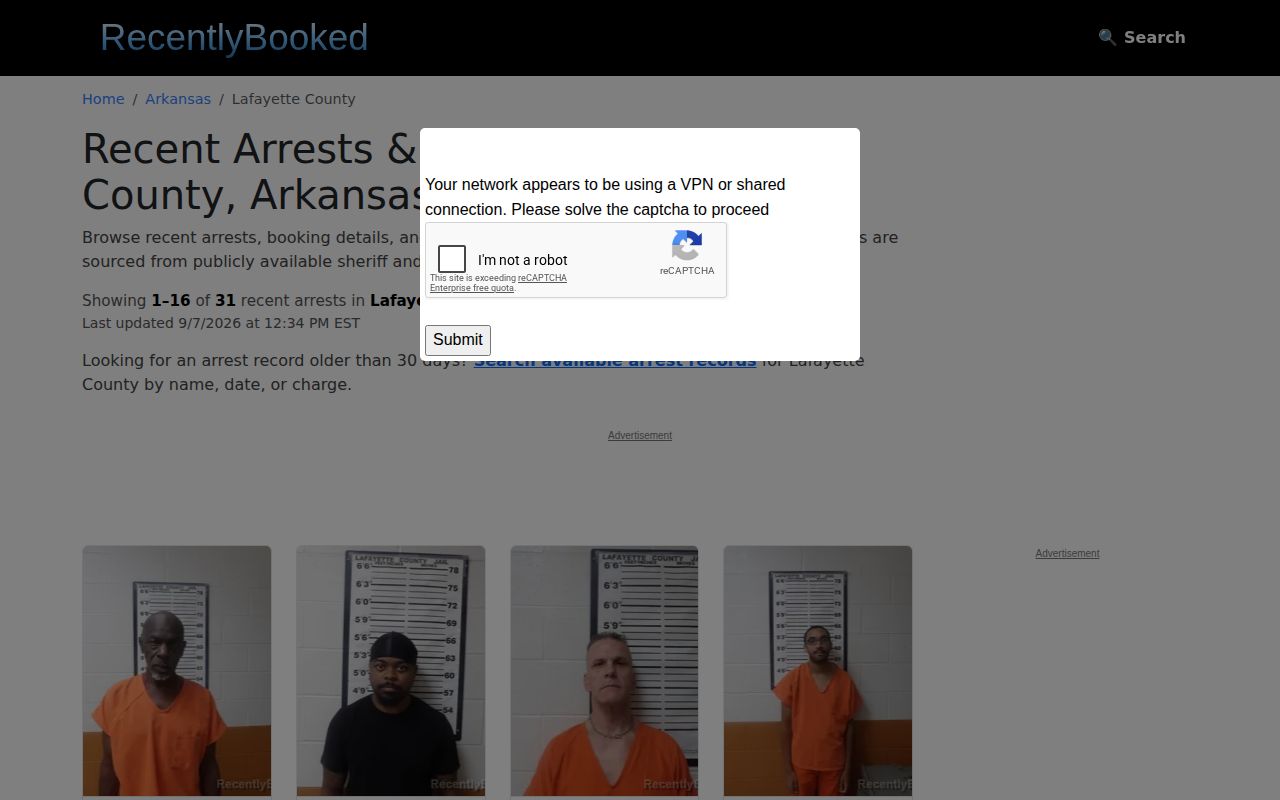
Third-party sites have real limits for Lafayette County arrests. Neither Arrests.org nor Mugshots.zone carries a section for Lafayette County, Arkansas. That Lafayette result belongs to the Louisiana parish. Local outlets such as KSLA, TXKToday, and Hope Prescott cover selected arrest stories from the region, but none runs a complete daily blotter. Their reporting can add detail to one named event. It cannot confirm total arrest counts. Before drawing any conclusion about a Lafayette County case, go back to LCSO, the court, or an official records response, and treat aggregator pages as leads only.
Recent Arrests by City
City police contacts matter for one reason. They tell you which agency made the arrest. The Lafayette County Jail stays the booking destination once a municipal arrest is processed. No mapped city here publishes a daily arrest log, so each city page explains the department, the court rhythm, and the county roster path instead of a feed that does not exist.
- Stamps Recent Arrests covers Stamps Police, the county booking route, selected regional reporting, and fourth-Monday city court scheduling.
- Lewisville Recent Arrests covers the county seat, Lewisville Police, first-and-third-Wednesday court sessions, and LCSO intake.
- Bradley Recent Arrests distinguishes the police contact from a historical community crime archive and the county feed.
Cities appear in order of population. The ranking comes from 2020 Census figures cited in the Encyclopedia of Arkansas and state GIS materials. It measures page scope, not arrest volume. An arrest made in one town can lead to a booking elsewhere, especially after a transfer or a cross-county hold.
Lafayette Booking Record Fields
A booking record marks intake. The public LCSO display keeps things brief. Arkansas's jail-log rule, 12 CAR § 50-503, expects a fuller detention record than that. Covered fields include demographic data, arrest and confinement times, release time, the reason for confinement, felony or misdemeanor classification, arresting or confining officers, and warrant or commitment data. A request can seek fields the roster omits.
| Record item | Meaning and limit |
|---|---|
| Booking number | Links intake materials when the agency assigns one. |
| Arrest and booking times | Separate the police event from jail admission. |
| Charge and class | Records the intake charge; it can later change. |
| Bond | States a release condition. |
| Warrant or commitment | Identifies authority to hold the person where releasable. |
| Release information | Shows movement out of custody, subject to transfer details. |
| Booking photograph | Documents intake identity and remains subject to disclosure limits. |
| Court case and disposition | Usually found through the court, not completed by the roster. |
Booked means processed into a detention facility. In custody describes status right now. Released means the person left that custody, though a detainer or transfer can change the practical result. A disposition is the court's outcome. These terms answer different questions, so keep them straight and turn to the originating police record, the full jail log, and the court file when a first roster check is not enough.
Lafayette Arrest Custody Stages
The right lookup shifts as a case moves along. A newest-first LCSO entry may show someone just booked into the Lafayette County Jail. Its release field is not a custody history. A blank or dash there proves nothing. A transfer, a delayed update, a citation, a release, or a booking in another county can each leave a different picture behind.
| Record state | Best official source | What to verify |
|---|---|---|
| Just arrested | LCSO roster, then direct LCSO contact | Allow for intake and posting delay |
| In county custody | LCSO roster and VINE | Confirm identity and current facility |
| Released or transferred | LCSO record request and VINE | Ask for release time and destination where releasable |
| Case filed | Search ARCourts and the clerk | Match court, case number, and disposition |
| In state correctional custody | Arkansas DOC offender search | Use ADC identity and facility fields |
| In federal or immigration custody | BOP or ICE locator | Use only the system tied to that custody |
Roster entries do not last. A past Lafayette County booking remains a public record even after it rolls off the display. The jail log and court file keep the details. For the later legal result, the court disposition is the record that answers it.
Lafayette Arrest Photos and Mugshots
The LCSO feed shows booking photographs. Its app configuration has images enabled. That makes it the safest photo source while a county intake still appears there. The office makes no retention promise, and the image travels through the app's content network rather than a permanent county archive. A copied image address may stop working or drift away from later court events.
State custody works differently. The Arkansas Department of Corrections offender search serves a later stage of the process. It searches by ADC number, county, name, facility, gender, offense category, age, and race. Profiles may include an inmate photo. County-only detainees may not appear. The official search screen makes that state-level line plain.
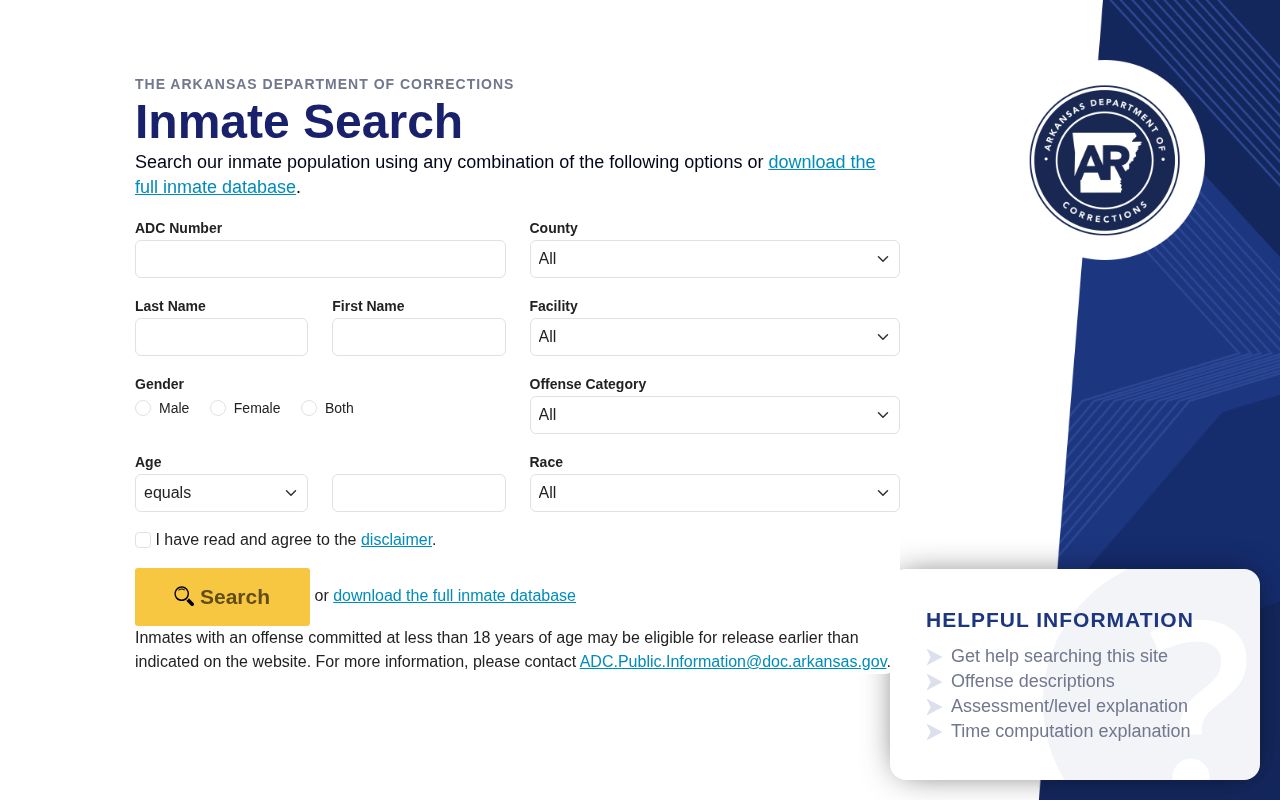
The ADC tool is not a fresh county booking check. Federal Bureau of Prisons results cover federal prisoners, and the locator offers no booking photos. If a photo rolled off, go to LCSO. Give the person's name and booking date. Ask for an electronic copy and accept lawful redaction. Arkansas law does not open every image on request. Juvenile material, victim information, sealed files, investigative records, and other protected content can all be withheld.
Lafayette Arrest Photo Links
An official Lafayette County booking image arrives through the Sheriff App feed and a content-delivery-network address. That detail has a practical effect. The readable inmate-search page and the direct feed can behave differently. A browser may render the roster while a text tool sees only a shell. A saved image address may fail later. That failure does not mean the record was erased. LCSO can still hold the booking record.
Use the roster URL as the access point. Treat a records response as the durable source. A CDN link is not an official archive citation, so do not save it as one. When an older photo serves a lawful records purpose, name the person and booking date in a focused LCSO request; Arkansas retention rules bind the agency's booking records, not the public life of each link.
Requesting Lafayette County Records
Lafayette County's sheriff forms page offers no dedicated booking-photo request. No local fee schedule appears there either. The Arkansas Freedom of Information Act fills that gap. When you write the records custodian, ask for specific booking records or an arrest roster. Don't request everything the office holds. State guidance generally requires access within three business days. That clock applies when a record sits in active use or storage. Actual reproduction and mailing costs may be charged. Three days is a target, though, not a guarantee. Exemptions, record location, clarification, and redaction can each stretch the response.
- Identify the person, approximate arrest or booking date, arresting agency, and Lafayette County Jail.
- List the records sought, such as the booking sheet, detention-log fields, release entry, and booking photograph.
- Ask to inspect the record or receive an electronic copy, and request the nonexempt portion if some material must be redacted.
- Send the request to the Lafayette County Sheriff's Office at 5 Courthouse Square, Lewisville, AR 71845. Verify whether 870-921-4252 or the separately published 870-921-4258 is the current route before sending sensitive details.
- Keep the response, fee quote, and any case number. Use Search ARCourts for the later disposition.
The Arkansas Attorney General's FOIA page explains the public-record framework and request guidance.
The sheriff app offers no dedicated request form, and official state guidance fills that gap. For an error, contact the originating office first. Sealing or expungement runs through the court and the Arkansas Crime Information Center. Unofficial publishers work differently. Use only a documented free correction or removal route where the site offers one. Skip any path that is not published. RecentlyBooked states a no-fee review path for a wrong person, a duplicate, juvenile matters, outdated information, or documented sealing. Never pay anyone claiming to alter the sheriff's record. And hold your identity documents until the recipient and its policy check out.
Arkansas Booking Records Law
Arkansas Code § 13-4-404 spells out what a jail booking record is. Fingerprint cards, booking photos, and detention logs all count. The statute sets a retention floor of five years. After that minimum, disposal requires a county-judge order made on the sheriff's recommendation. Retention is not publication. A five-year floor does not keep every item on the public website, so older arrest records should be requested from LCSO and traced through court or archival channels when needed.
A sealing order restricts a record. The paperwork runs through the court and ACIC forms. A web request alone changes nothing legally. Search engines can also lag behind a corrected source. Fix or remove the source page first, then run the search provider's outdated-content process. Some material needs special review before any use. That covers juvenile details, victim information, sealed matters, and active investigative files. An arrest feed that looks public is not a license to republish everything in it. For older cases, the Arkansas State Archives research service helps identify finding aids and copy options. Its holdings are selected material, though, not a current Lafayette County booking-photo database.
Protected Lafayette Arrest Records
The sheriff's public app states no separate juvenile-photo policy for Lafayette County. Silence is not permission. Names, images, and case details are not all publishable. Law may withhold or redact juvenile matters, victim information, sealed records, active investigative material, and safety-sensitive facts. The Arkansas Crime Information Center maintains separate sealing and expungement forms, including ones tied to juvenile orders.
See protected data inside a roster entry? Ask the custodian for the nonexempt part rather than the whole file. Expungement seals a qualifying record under an order. No one edits the sheriff feed directly through it. A page that once showed an arrest can also linger in search results after the official record changes. Correction begins with the source and the court order.
Arkansas Mugshot Removal Law
Arkansas Code § 4-75-102 aims at private booking-photo publishers that charge for takedown. The law has real teeth. A qualifying request triggers a free removal process, a five-business-day window, and contact and transparency duties. It does not ban every booking-photo publication. Nor does it make LCSO a removal desk.
Wrong Lafayette County entry? Fix the official source first. Sealing and expungement issues belong with the court and the ACIC process. For an unofficial site, use its documented free route and provide only the proof its policy requires. RecentlyBooked describes a no-fee review for a wrong person, a duplicate, juvenile matters, stale information, or documented sealing. Refuse anyone demanding payment to change official records.
Lafayette Arrest Warrants and Wanted List
LCSO maintains an official most-wanted page. No public county warrant-search portal exists. The two are different resources: a wanted page shows selected items chosen for display, so it cannot confirm that every active warrant is listed. The page carries one manually published entry. No update schedule is stated. A warrant is court authority for an arrest, and a wanted poster is not a recent-arrest log. The official Lafayette County most-wanted screen displays the sheriff's selected-publication format.
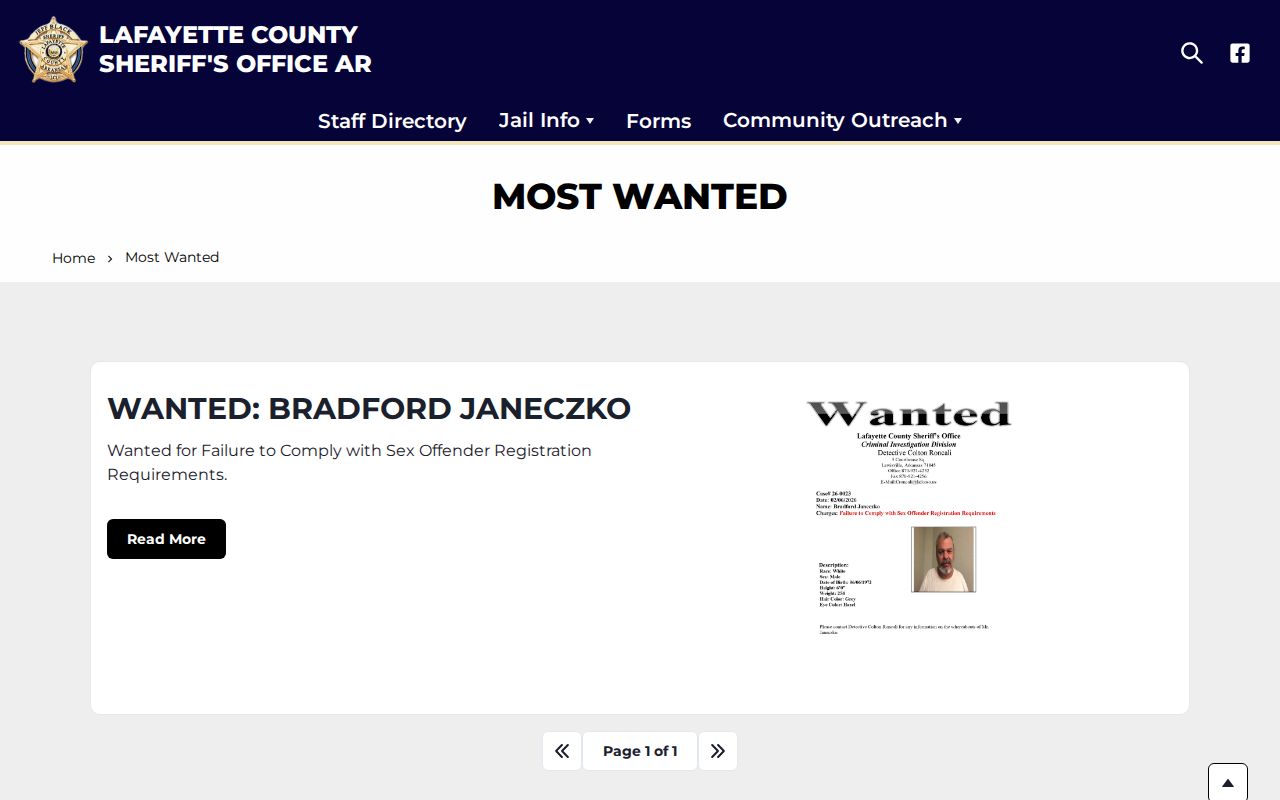
Confirm warrant status through LCSO, the issuing court, or an attorney. Never approach someone on the list. Send nonemergency tips through the sheriff's official channel. Call emergency services when danger is immediate. The tip form promises neither anonymity nor a reward, so assume neither.
After a Lafayette Arrest
Booking ends the jail's part. Then the case moves to court. The first appearance is an arraignment, where the judge states the charge and may set conditions for release. Bond belongs to that conversation. It is a release condition, nothing more. Not a penalty, and not a judgment of any kind.
From there, a Lafayette County case travels through district or circuit court. Search ARCourts is the statewide case system for tracking it. Patience helps here. A brand-new arrest may take time to show up, and a common name can pull false matches. Before trusting a result, confirm the case number, the court, and the filing details with the clerk.
The county's official district schedule adds local flavor. Lewisville city and county criminal and traffic matters sit on the first and third Wednesdays. Bradley and Stamps hold their sessions on assigned Mondays. That rhythm explains why a hearing can land on a different day, in a separate system, from the booking itself. It promises nothing about any one person's date. When the case ends, the court's disposition tells the story: dismissal, reduction, acquittal, plea, or conviction.
Lafayette Arrests Reach Court
A Lafayette County arrest can leave a trail in three places. It starts with the officer or deputy who makes the stop. The Lafayette County Sheriff's Office then creates the county booking entry. A district or circuit court may open a case file after that. The jail roster tells you who is in custody right now. Search ARCourts tells you where the case stands.
A docket shows the filings, the hearings, and the final outcome. But timing can trip you up. Docket entries often lag behind a fresh arrest. Some case files are sealed or incomplete online. A docket can even get mixed up with another person who shares the same name.
Lafayette County's official district schedule treats Lewisville city and county criminal or traffic sessions one way. It assigns the Bradley and Stamps sessions separately. That local arrangement explains why a court event may land on a different date. It can surface through a different office. The schedule never promises a specific hearing date for anyone. Match the booking to the court name, case number, and filing details. Let the clerk confirm before you rely on it.
Custody Beyond Lafayette County
Custody does not always stay in Lafayette County. Some people move into state correctional custody after sentencing. They may show up in the Arkansas Department of Corrections search. County-jail time alone does not create an ADC entry. The transfer itself can take time. An ADC profile may carry a photo and sentence details. Still, it cannot replace the Lafayette booking record or the court file that explains the case.
Federal custody works differently again. The Federal Bureau of Prisons locator tracks people in federal prison. It shows no booking photographs. The ICE Online Detainee Locator handles immigration detention, with its own identity requirements. Neither one substitutes for an ordinary Lafayette County booking search.
VINE covers participating Arkansas county and state custody notifications, offering status checks and alerts. It skips federal custody and serves as no photo source. Pick the system based on where the person sits today, not where the arrest happened.